
You hit “submit” on your dream job application — and then nothing. Days turn into weeks, and your inbox remains painfully silent.
But it’s probably not personal. Recruiters and hiring managers are drowning in applications (on average, they’re sifting through 257.6 applications for every single position). Your carefully crafted resume is just one voice in a very crowded room.
So how do you rise above the noise without seeming pushy or desperate?
The answer is a well-timed, thoughtfully written follow-up email.
Below, you’ll find a proven follow-up email template, along with expert tips on timing, tone, and what to avoid.
Table of Contents
Get Hiring Manager Emails for Your Follow-Ups ✉️
Stop sending follow-ups into a black hole. JobCopilot helps you find verified hiring manager emails and LinkedIn profiles for the jobs you apply to, so you can contact decision-makers directly and increase your chances of getting a response.
Find Hiring Manager Contacts →Why You Should Follow Up on a Job Application
The job application landscape has become a battlefield. As AI speeds up the job application process, recruiters are facing higher volumes of applications than ever before.
In this sea of sameness, a personalized follow-up email is what separates you from the pack.
You might worry that sending a follow-up email will annoy an already overwhelmed recruiter. Actually, it’s the opposite. Many hiring managers and recruiters say that not following up is a mistake that significantly reduces your memorability.
A strategic follow-up shows you’re:
- Genuinely interested in the role
- Proactive and willing to take initiative
- Professional enough to understand business communication norms
A follow-up email hurts nothing and improves your odds. If anything, it signals to employers that you’re proactive, genuinely interested, and willing to go the extra mile.
Take Mariana Kobayashi, who landed a job at Google (a company that receives millions of applications yearly and is nearly 10 times harder to get into than Harvard). After initially being told she was overqualified for one role, she followed up every two months with the recruiter, staying on their radar until the right position opened up—and that persistence landed her the offer.
When to Follow Up (Timing Guide)
Your follow-up should hit the sweet spot:
Too soon + annoying = ignored
Too late + forgotten = missed opportunity
Just right = noticed
There’s no hard and fast rule, but here’s a proven timeline that works:
Follow-up | Timing |
First follow-up | 1–2 weeks after applying |
Second follow-up | 1 week after the first follow-up (if no response) |
Third follow-up | 2 weeks after the second follow-up |
Here are some exceptions to these timing rules:
- You have an internal referral or connection: You can follow up slightly sooner (around 1 week) since you have a warm introduction
- The posting says “no calls or emails”: Respect their process and don’t follow up unless you have a direct contact
- You interviewed already: Follow up within 24-48 hours with a thank-you email, then wait the timeframe they provided before checking in again
- It’s a fast-moving industry or urgent hire: Tech startups and roles marked “immediate hire” allow for quicker follow-up (around 5-7 days)
Holiday seasons or company events: Add a few extra days to account for out-of-office schedules and conference season
How to Write a Follow-Up Email After a Job Application
The tone of your follow-up email matters just as much as the timing. You want to strike a balance between professional and personable.
Some essential elements to include:
- Clear subject line
- Brief greeting
- Application reminder
- Continued interest
- Add value
- Polite ask
- Professional close
50–125 words are the sweet spot for the length.
Note: If you met multiple people during the interview process, send individual notes to each interviewer rather than one generic message.
The biggest challenge is finding who to actually email. Job postings rarely list a direct contact, leaving you to guess or use generic “careers@” addresses that go into a black hole.
Here’s how to find the right person:
- LinkedIn search: Look for recruiters or hiring managers at the company with relevant titles
- Company website: Check the “Team” or “About” pages for department heads
- JobCopilot: Automatically finds and reveals verified hiring manager emails and LinkedIn profiles for every job you apply to (no manual hunting required)
Mistakes to Avoid When Following Up
A good follow-up can open doors. A bad one can slam them shut. Even with the best intentions, certain missteps will make recruiters hit delete faster than they can finish reading.
Here’s what kills your chances:
- Following up too soon: Sending an email 2-3 days after applying makes you look impatient, not enthusiastic. Give them at least a week.
- Sending multiple follow-ups too close together: Emailing 2-3 days after your first follow-up signals desperation. Space them out by at least a week.
- Writing long paragraphs: Dense blocks of text get skipped. If your email needs scrolling, it’s too long.
- Sounding entitled or demanding: “I haven’t heard back and need an answer by Friday” is a fast track to rejection. You’re requesting an update, not issuing an ultimatum.
- Copy-pasting without customization: Generic “just checking in” emails are obvious and forgettable. Reference the specific role, company, or your conversation.
Using overly casual tone: “Hey! Just wanted to see what’s up with that job lol” won’t get you hired. Keep it professional, even if the company culture is relaxed.
Free Job Application Follow-Up Email Templates
Use the templates below as a starting point. Customize them with the job title, company name, and any relevant details from your application or interview. Keep your message concise, professional, and specific.
Email 1
Subject: Application for [Job Title] – [Your Name]
Hello [Hiring Manager’s Name],
I hope you’re well. I wanted to briefly reach out to let you know that I’ve just applied for the [Job Title] position at [Company Name].
I’m very interested in this opportunity and believe my background aligns well with the role. I’ve attached my CV for convenience and would be happy to provide any additional information if helpful.
Thank you for your time and consideration.
Best regards,
[Your Name]
Email 2
Subject: Following up on my application – [Job Title]
Hello [Hiring Manager’s Name],
I hope you’re having a great day. I recently applied for the [Job Title] role at [Company Name] and wanted to personally express my interest in the position.
I’m very excited about the opportunity to contribute to your team. I’ve attached my CV for easy reference and would welcome the chance to discuss how my experience could add value.
Thank you very much for your time.
Kind regards,
[Your Name]
Email 3
Subject: Very interested in the [Job Title] role at [Company Name]
Hi [Hiring Manager’s Name],
I hope you’re doing well. I’ve recently applied for the [Job Title] position at [Company Name] and wanted to reach out directly to share my strong interest in the role.
I’d love the opportunity to contribute my skills to your team. I’ve attached my CV for your review.
Thank you for your consideration, and I hope to speak with you soon.
Best regards,
[Your Name]
Email 4
Subject: Application submitted – [Job Title]
Hello [Hiring Manager’s Name],
I’m reaching out to let you know that I’ve applied for the [Job Title] position at [Company Name].
I’m highly motivated to join your team and believe my experience is a strong match for the role. Please find my CV attached, and feel free to reach out if you’d like to discuss my application further.
Thank you for your time.
Best regards,
[Your Name]
Find Hiring Manager Emails to Send Your Follow-Ups
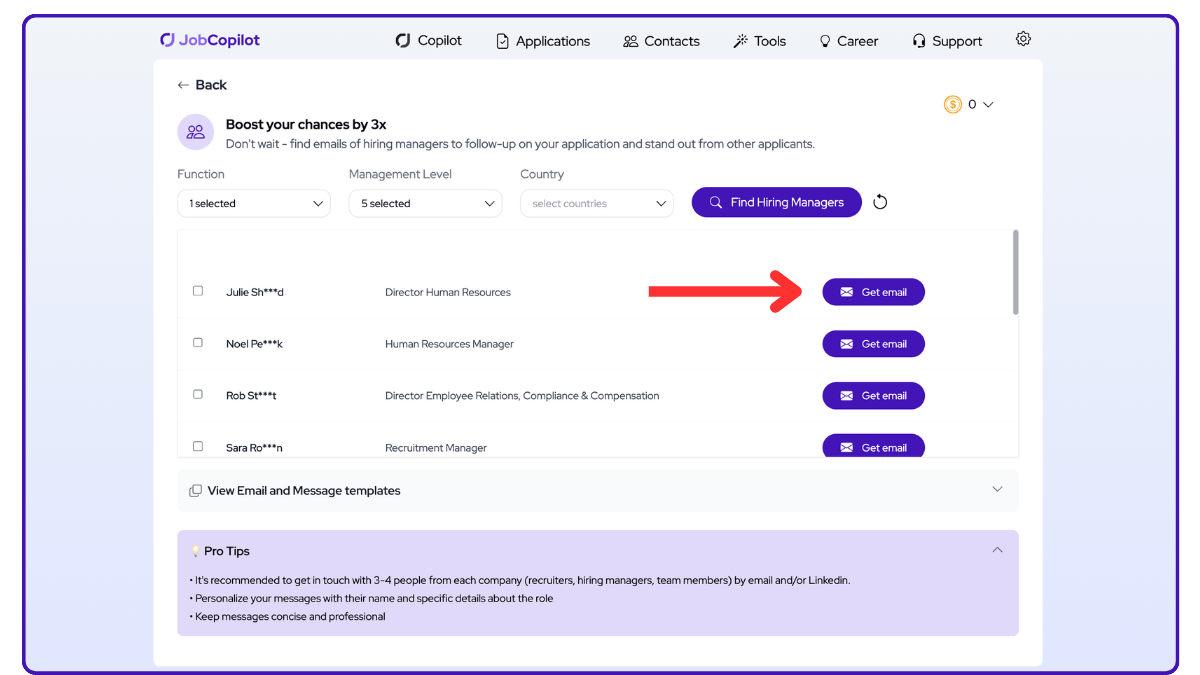
Writing a strong follow-up email is only half the battle. The other challenge is finding who to actually send it to.
Most job postings don’t list a direct contact, leaving candidates guessing or sending messages to generic addresses like careers@company.com that rarely get noticed.
JobCopilot helps solve this problem.
For every job you apply to, JobCopilot can reveal verified hiring manager emails, allowing you to send your follow-up directly to decision-makers.
Instead of waiting in the applicant pile, you can:
- Contact recruiters and hiring managers directly
- Send professional follow-ups that stand out
- Increase your chances of getting a response
 Use JobCopilot to find hiring manager emails and send smarter follow-ups
Stop Getting Ghosted After Applying 👀
Most job applications disappear into crowded inboxes. With JobCopilot, you can find and contact hiring managers directly by email or LinkedIn to send a professional follow-up and stand out from other applicants.
Find Hiring Manager Emails →Frequently Asked Questions
What if I never get a response after following up multiple times?
After your third follow-up with no response, it’s time to move on. Assume it’s a no and redirect your energy to other opportunities.
Can I follow up on LinkedIn instead of email?
Yes, if you can’t find an email address or if you’ve already connected with the recruiter there. Keep it just as professional and brief as an email. LinkedIn messages can actually get noticed faster in some cases.
Is it okay to call instead of sending an email?
Email is almost always better. Calls can feel intrusive and put recruiters on the spot.
Should I include new achievements or information in my follow-up?
Absolutely, if it’s relevant. Completed a certification? Launched a project? Won an award? Highlighting new accomplishments demonstrates that you’re actively growing and gives the recruiter a reason to reconsider your application with fresh eyes.